
饮食男女
23 humanoid robot teams compete in rescue missions at 2nd WHRG, facing real-world complexity beyond dancing in coordination_我的网站

一 | 8 月 25 日消息,七彩虹 (Colorful) 今日宣布,旗下 COLORFIRE 游戏笔记本电脑新品橘宝 MEOW X16 Pro 开启预售。这一产品将于 9 月 1 日 10:00 正式发售。
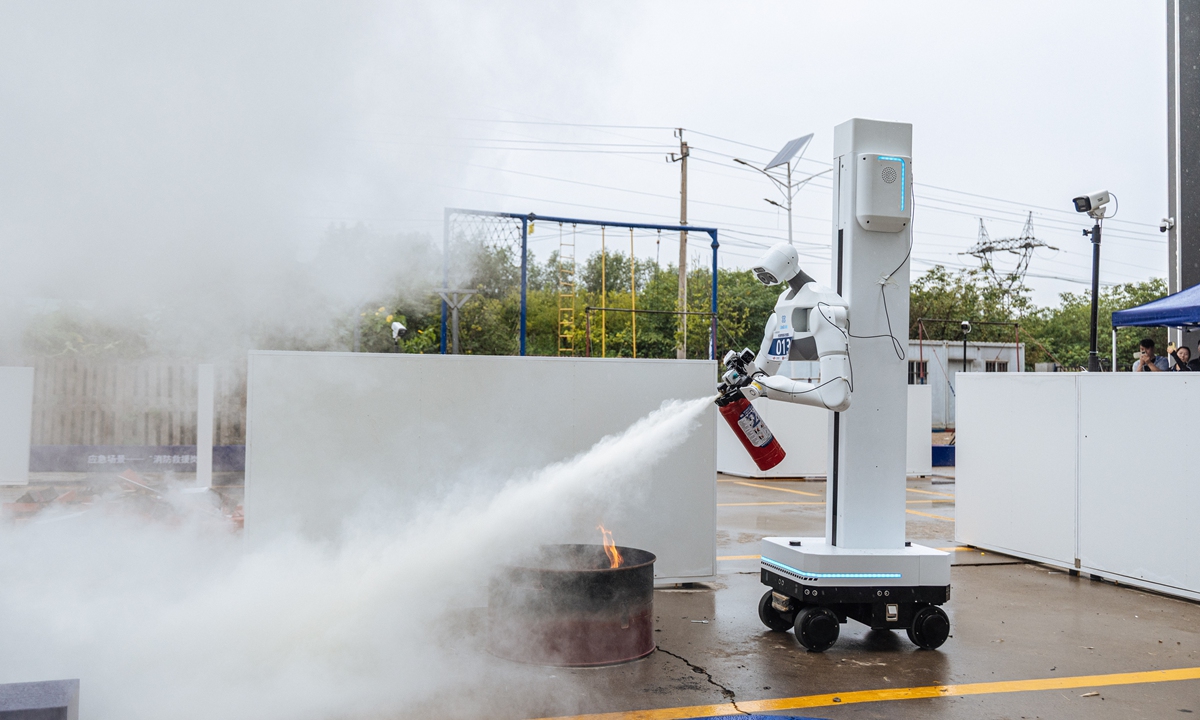
The firefighting final of the emergency management category at the 2nd World Humanoid Robot Games (WHRG) was held on Sunday in Beijing, putting 23 teams through a simulated rescue operation designed to test whether humanoid robots can move beyond demonstrations and perform practical tasks in complex real-world environments.
The event comes as Chinese humanoid robots, long known for eye-catching abilities such as running, dancing and music playing, are pushed toward practical applications, including jobs that are dangerous for humans such as emergency rescue.
Unlike the first edition of the WHRG last year, according to the organization committee, this year's scenario-based events emphasize "realistic simulation," with the firefighting competition being held at a fire brigade rather than in a model-room setup.
The competition simulated a firefighting assignment that required each of the 23 robots to complete three tasks within 30 minutes: identify hazardous materials, shut off valves and operate a fire extinguisher. For the first task, robots had to identify two randomly placed simulated hazardous substances and report their types to judges through returned images. They then had to locate three randomly selected open valves of different types and shut them off before identifying a fire source, finding a fire extinguisher and spraying it until the fire was put out.
Human firefighters were also involved in the event, lighting the fire and observing whether the robots carried out the extinguisher operation correctly.
The competition, however, showed how difficult it remains for robots to perform reliably outside controlled laboratory conditions.
Rain affected the competition, while changes in lighting and the outdoor environments added uncertainty to the robots' visual recognition and manipulation tasks. A team from UniX AI, a company well-known for its robot applications on real-world scenarios and has just raised a new round of 300 million yuan ($ 44.49 million) in late March, completed its run within the allotted time, but its robot moved relatively slowly compared to human firefighters' real practice. When operating the fire extinguisher, its robotic hand had to make two attempts to align with the target.
Of 12 teams competed on Sunday, three finished the challenge.
Yang Liqi, a representative of the UniX AI team, told the Global Times that the firefighting scenario placed higher demands on both the robot's recognition and manipulation capabilities.
"Rain and lighting conditions can affect the robot, and actual situations are often different from what we simulate in the laboratory," Yang said, noting that this was also one reason why a number of teams were unable to complete their runs on Sunday morning.
The team had programmed the robot to make up to three attempts when operating the extinguisher. "If it sees white smoke after the first attempt, it will not make a second attempt," Yang said.
The difficulty was not simply that whether the robot could move its arm. Humanoid robots rely on different types of joints for different tasks: small, high-precision joints enable delicate hand operations, while high-torque, reliable joints support movement and balance.
A failure at any point of actions and detection could affect the final result. This is precisely where the value of real-world competitions lies, Jin Chenran, a representative of the Tiangong team whose robot only accomplished one of the three tasks, told the Global Times.
"Whether the competition goes smoothly or not, that is the significance of a real-world simulation. Every real-world failure is valuable data that helps humanoid robots toward practical application," Jin said.
Jin further explained that questions like why the robot failed to recognize an object and how its motion-planning system selected the wrong path... Such data can subsequently be used to improve algorithms and train AI models.
The competition also offered a glimpse into the current transitional stage of humanoid robot technology. At the venue, some team members were wearing VR headsets and remotely adjusting their robots shortly before their runs.
Some humanoid robots were seen using omnidirectional wheels instead of feet, while their hands featured multiple joints to enable more precise manipulation. Many teams chose China-developed UBTECH's joint modules for their robots. Its servo actuators cover a wide torque range from 0.2Nm to 200Nm, allowing robots to combine dexterity with strength. Meanwhile, VR teleoperation gives operators a first-person view through the robot's cameras, enabling them to remotely guide movements in real time.
The event comes amid a broader push in China to move humanoid robots and embodied intelligence from laboratories and competition arenas into real production and daily-life environments. In June, the Ministry of Industry and Information Technology and the other departments launched a special program for humanoid robots and embodied intelligence that encouraged applications in practical fields including emergency rescue.
Zhao Weidong, deputy director of the organizing committee office, told the Global Times that the scenario-based competitions are intended to test the progress of humanoid robots from "competition performance" toward "real operational work," including whether they can eventually become intelligent partners for firefighters.
"At present, many simulations of actual operations may still be at an early stage," Zhao said. "But these are an important starting point for enabling robots to truly assist humans in real-world environments, as well as an important source of data and testing."
The ultimate goal, Zhao said, is to push robots into fields where human operations are dangerous and achieve genuine "human-robot complementarity."
。MEOW X16 Pro 硬件上提供 AMD 锐龙 7 8745HX 处理器、NVIDIA GeForce RTX 5060 笔记本电脑 GPU、16GB DDR5-5200 SO-DIMM 内存、512GB PCIe Gen4 SSD 存储,券后首发到手价 10399 元。

二 | 作为一款名字中带有 "MEOW" 的硬件,MEOW X16 Pro 整体采用融入猫系元素的“橘影白”外观方案。

三 | 其机身整体采用冲压磨砂工艺,A 面键盘、暗藏橘宝猫系 3D 纹理丝印,C 面提供橙白撞色珠光涂层、猫爪纹触控板。该游戏本内置 2 风扇 4 热管、4 出风的“酷冷 2.0”散热系统,支持 170W 整机性能释放,噪声水平 50dB。此外其配备 16" 2560×1600 180Hz 500nit 的 100% sRGB 色域 IPS 屏幕,内置 80Wh 电池,支持 Wi-Fi 6E、2.5GbE,提供 3A2C 的 USB 端口。此外,COLORFIRE MEOW X16 Pro 还支持七彩虹的环域智控手机互联生态系统,内置离线唤醒引擎与 AI 语音芯片,支持远程语音开机、无感解锁,还能让智能手机化身远程幻灯片翻页笔或者手柄控制器。京东七彩虹 COLORFIRE MEOW X16 Pro 游戏本 9 月 1 日 10:00 发售券后 10399 元领 300 元券广告声明:文内含有的对外跳转链接(包括不限于超链接、二维码、口令等形式),用于传递更多信息,节省甄选时间,结果仅供参考,包含外链的文章均包含本声明。
Current article:http://9b1b.feishuozhuangkeqi.cyou/0er8wlt/20260826/4226.html
Published on:20:12:14


1
杭州机场今日取消航班74架次,10点以后机场运行有望全面恢复!杭深铁路、沪昆高铁部分列车停运2
北京发布会:最大限度防范疫情输入,最大程度实现早发现、早控制3
仰望U7创新世界纪录!耗时8天19时58分完成3万公里耐久测试4
Militant training at several secret hideouts in hills of B'desh: RAB5
前绿党议员被警方指控两项入店行窃罪,下月出庭6
潜入幽暗地下!《方块方舟》地下迷城全新BOSS与特色生物抢先看7
记者:罗德里参加合练有望战毕巴迎首秀,加维、德容单独训练8
Joe Biden's ‘Deadly Open Border Policies’ Blamed by Texas Gov. For ‘Stacks of Bodies’ Found in Lorry9
推荐官超话丨河北五超第十五轮即将打响,致敬赛场每一份拼搏!10
USB 80Gbps接口标准正式发布 USB 3.0/USB4称呼被淘汰11
苹果旗下天气应用Dark Sky将于2023年停止运营12
Battery Swapping to Lead to Growth of Electric Vehicles in India, WEF Advisor Says13
英伟达AI服务器将涨价15%!1GW数据中心成本激增50亿美元14
AT去年刚建的人行横道被拆除,奥克兰纳税人的钱就这么糟践?!15
US says Iranian drones breach sanctions
- 随机推荐
1
视觉中国:持股5%以上股东梁军拟减持不超3%股份2
真矢さん訃報発表から一夜、メンバーが改めて悲痛コメント「本当に寂しい…」「真ちゃんのために」3
高键会见淮安市党政代表团4
央视曝光解放军赴地震灾区一幕,说出为啥印度在高原上耗不过中国5
谷歌云推出面向法律行业的Gemini企业级解决方案6
手拉手爱心协会徐大堡分队帮扶困难家庭7
贵州国资成立产业并购股权投资基金8
冰雪消费持续转化为经济增长新动能9
夏日送清凉,关怀暖一线——上海福彩开展夏季慰问活动10
Hurricane Norma takes aim at Mexico's Los Cabos resorts, as Tammy threatens islands in the Atlantic11
Man convicted of murdering wife in dispute over 'Zombie House Flipping' appearance12
望海满族乡四方村:配备性能齐全垃圾箱 300盏路灯亮化13
1至7月,2.06亿人次涌进武林商圈 老商圈解锁AI新玩法14
娄底:“福泽潇湘 爱润童心”活动助力福利院孩子心灵成长15
Aidian Port on China-Vietnam border resumes customs clearance